Saturday, 28 January 2017

All hail the (winter) King

Kingdom: Plantae
Family: Rosaceae
Species: Crataegus viridis
Crataegus viridis is known as the Winter King hawthorn tree, due to its berries being present all throughout winter, right up until March. The fruits are around half an inch in diameter, and start out green, then ripen from orange to bright orange-red in early winter and remain attractive until late winter. Birds do not care much for the berries, and therefore they tend to avoid them until food sources are running scarce. 


For a hawthorn tree it actually has relatively few thorns and in winter it displays an exfoliating bark which is of interest. These trees have clearly been recently planted and therefore the bark is not a highlight of the tree's appeal yet. Compared to other hawthorns, the Winter King is relatively resistant to common diseases such as scab and rust. It is also tolerant to most soil types and city pollution, which makes it a popular choice in urban landscaping. At maturity, the tree stays fairly small at up to 25 to 30 feet tall, with a rounded vaselike shape. This short stature makes it ideal for tight spaces, in the small green spaces within the UEA campus rather than the surrounding grounds. The grey backdrop of the buildings allows the foliage to stand out in all seasons.

The tree is a four-season tree, with white flowers in spring, which show up nicely against the green foliage. The flowers have five petals and are meladorous (a bit smelly!). It bears a clean summer foliage of a dark green colour with a leathery texture, and golden-yellow fruits in fall and winter, which cheer up an otherwise bleak and blank winter canvas. To top it all off, in autumn the leaves undergo a beautiful transformation thanks to senescence, turning gold with traces of red, purple and maroon. When they fall, they reveal the exfoliating bark which reveals a warm copper-cinammon colour. Due to being a young tree, this is more a silvery-green colour.

This tree is clearly worthy of its royal appointment as Winter King. However, it deserves credit for the other seasons too, as it retains its beauty in different forms throughout the year.

Thursday, 26 January 2017

The Oregon Grape - An early bloomer


Kingdom: Plantae
Family: Berberidaceae
Species: Mahonia aquafolium
The flowering plant Mahonia aquafolium (is it just me or does that sound a bit like a Harry Potter spell?) is also known as the Oregon grape, due to it being native to North America and the blue-purplish berries it produces in late spring and summer. These berries are edible by humans, but not on their own due to their tart taste, so they are instead often used in jelly. The shrubs look very different now compared to how they will in a few months when the berries have been produced! The Oregon grape is an evergreen shrub, with spiky pinnate leaves (appear in pairs either side of the stem) and clusters of yellow flowers which form in racemes and bloom in early spring. These flowers attract pollinators such as bees and hummingbirds. These flowers appear very early in the spring, I took these pictures in mid-January, so it attracts pollinators before most other plants have flowered!


It is easy to see why UEA have decided to choose this plant to brighten up their campus in the area in front of the shop - they are easy to grow and to establish they require only a small amount of water. Once established, they are fairly drought resistant. They are also resistant to disease and the leaves are tough and insects are unable to mess with them. However, the leaves can become chlorotic in soil that is too alkaline and can suffer leaf-burn in winter winds. Luckily they are quite protected where they are situated on campus, so winds are minimal. They provide all-year round green appeal, combined with their golden flowers and blue berries. They are also easy to maintain with just a small amount of trimming required. They can grow in mostly shaded areas, so have been planted in an area near several trees. They are most popular in urban landscaping due to their high chemical pollutant tolerance, although hopefully this isn't why it has been planted at UEA!


Monday, 23 January 2017

Aren't you sweet?

Kingdom: Plantae
Family: Violaceae
Species: Viola orodata

The English violet, or sweet violet (Viola odorata) has recently appeared outside my accommodation right next to the daffodils which seem to completely cover the UEA campus lately. They are characterised by 5 purple flowers (or blue or white) with pinnately shaped leaves arranged in a basal rosette. They grow to a height of 4 to 6 inches, often at the edges of forests or in clearings. Or outside Britten House. They are aromatic, although this smell is mysterious as it seems to disappear after a single sniff. This is because the flowers contain iodine which desensitizes the sense of nose and therefore the sense of smell! However, because the scent is so well-liked it is widely used in perfumes and oils. I don’t know why you’d want a perfume that you literally can’t smell after the second you put it on? I know I wouldn’t pay for it.

There are hundreds of different species of violets (around 400-500), which happen to be the birth flower of February (although sweet violets are technically “violas”, not true violets). They symbolize loyalty, fertility and love, and have been around since Ancient Greece – around 500 B.C. Greeks used violets in their wines, foods and medicines, even in love potions! The scent also suggested sex, and so the violet was an emblematic flower of Aphrodite. In Greek mythology, Iamus, son of Apollo, was abandoned at birth. She left him lying in the Arkadian wilds on a bed of violets where he was fed honey by serpents. He was discovered by pass shepherds who named Iamus after the violet bed.

They were loved so much it became the symbol of Athens. Pliny recommended that a garland of violets be worn above the head to ward off headaches and dizzy spells. They were also used by the Romans for herbal remedies, wine and for festivals.

They can also be used in cooking as they do have some nutritional value – the petals are often coated with sugar and be used to decorate cakes or in chocolate. However, they contain vitamin C (more than most vegetables actually!) which is an antioxidant which can improve the immune system. They should not be taken in in large doses though, and are a laxative in medicine. It can also be used in treating respiratory ailments, insomnia, and skin disorders, but there is little evidence to support their effectiveness of any of these treatments.


Monday, 9 January 2017

Pine trees and their leaves

Kingdom: Plantae
Family: Pinaceae
Genus: Pinus
Pine trees are trees with evergreen leaves – they are green even in the middle of winter, adding a bit of colour to a forest that would otherwise appear bleak and dreary. They often grow to great heights. All species in the Pinaceae family have distinctive needle shaped leaves arranged in bundles, it is their most defining feature. The leaves have all the usual features of a leaf despite a different appearance – they have a waxy cuticle and stomata for gas exchange. Pine oil can be extracted through steam distillation of the needle-like foliage, and is popularly used in aromatherapy.

There are two types of pine leaf. Needles are arranged in bundles called fascicles, and there are 2 or 3 in diploxylon pines and 5 in haploxylon pines. Diploxylon (Pinus) and haploxylon (Strobus) are subgenuses within the genus Pinus. There is actually a third subgenus, containing only one species called Pinus krempfii, which has flat un-pinelike needles and is found in Vietnam. This is clearly an example of a diploxylon pine, also known as the hard pine.


Diploxylon pines are stiffer and have stomata on both the ventral and dorsal surfaces. The basal sheath lasts the lifetime, whereas it is shed or curves to form a rosette in haploxylon pines. In haploxylons, there is one fibrovascular bundle whereas in the diploxylons, as observed here, there are two fibrovascular bundles. This is the feature which sets them apart taxonomically. Fibrovascular bundles connect with the xylem and aid in transport of nutrients, sugar and water.

The trees symbolise longevity and wisdom, and legend says that its needles can protect people from illnesses and witchcraft. Some Native American tribes regard the pine tree as sacred. Different cultures from all around the world use the pine tree for different purposes and consider it valuable for different reasons. For example, in Korea it represents virtue, and is viewed as being honourable, strong and wise, and is revered. Traditional Korean people even pray to a sacred pine tree for good luck, prosperity and health. Pine branches are left on the doorsteps of homes who have just had a baby to congratulate the couple, and the branch may be tied to a rope made of straw with charcoal if the baby is a girl, to keep evil spirits away. The Korean pine tree is also regarded as a messenger that transports the souls of the dead to the afterlife. Many coffins are made of pinewood which helps facilitate transportation of the deceased's soul to Heaven.


Wednesday, 30 November 2016

Funny place to find a chicken?

Kingdom: Fungi
Family: Fomitopsidaceae
Genus: Laetiporus
“The chicken of the woods”. This may sound like some wild species of chicken which roams freely in forests, but it is actually a fungus that grows on decaying deciduous trees (much less exciting, I know). The name comes from the fungus’ extraordinary resemblance to chicken meat when it is cooked, although not all parts of the mushroom is edible. It has the same texture and ‘peeling’ you get with chicken, and the taste resemblance is also said to be remarkable. It is even used as a vegetarian substitute for chicken as a delicacy. If not cooked properly, however, it can give you bad stomach pain, although not as bad as if you eat uncooked actual chicken meat! It can also give you swollen lips, nausea, vomiting, and dizziness, so double check the cooking instructions if you’re giving it a go.


The colour of chicken of the woods varies from species to species, ranging from an off-white colour to bright orange. This is one of the paler specimens, especially due to the time of year. They usually grow between May and November so this specimen is now likely very old, leading to it becoming paler and almost chalk-like. As it has passed is prime, it is likely that this specimen would give you some of the symptoms I mentioned earlier if you ate it, even if you cooked it properly. They are important in breaking down tough materials wood is made of and returning the nutrients from the decaying organism to the soil.


They can grow up to huge sizes, and as this is clearly a large bracket of the mushrooms it is likely that it has been cut back, which is why they lack the normal lobed structure. It is likely that it hasn’t been completely removed as this way it can continue decomposing the dead wood without creating an obstruction on the path, and it removes the need for the big task of removing the tree stump manually. What a useful little chicken!


Monday, 28 November 2016

A splash of colour!

Kingdom: Plantae
Family: Cornaceae
Species: Cornus sanguinea
One of the most brightly coloured shrubs growing around the UEA broad is the red dogwood. Dogwoods produce creamy white flowers in the spring, followed by blue/white berries with dark green leaves, which redden in autumn. The leaves then fall to reveal beautifully brightly coloured stems due to being a deciduous species. They are an independent species, and need very little management although coppicing should take place every February/March, cutting them down to a woody base within 4” of the ground before they bud. They need full sun to partial shade and are in a good location for sunlight next to the UEA broad, in an area that has few trees to obscure sunlight. They most often grow on the margins of woodland so they fit right in! They aren’t fussy about their soil conditions and can grow in damp soil, which is usually where they grow if wild. They are wildly sold as plants for people to plant in their gardens too, usually to add colour in winter. Their flowers are hermaphrodite and are small at around 5-10 millimetres in diameter and are insect pollinated. They produce a black berry fruit containing a single seed, called "dogberries".


This species of dogwood is native to most of Europe and Western Asia. Its leaves provide food for some animals, and dogberries are eaten by some mammals and many birds. Other species of dogwood are native to North America and Eastern Asia, where they have been traditionally used for a variety of purposes. Native Americans use the inner bark in tobacco mixtures in their sacred pipe ceremony. Some tribes eat the sour berries (usually eaten by birds – up to 18 species) to treat colds and to slow bleeding, whereas others made arrow shafts and tools from the branches and shoots due to the wood being so hard. This lead to the origin of the name “dogwood” – this has nothing to do with dogs, instead it originated from an old word “dag” which refers to a sharp tool. The leaves, bark and roots were also used to make medicine, and it is widely used for basket weaving. If bark is gathered in early spring, it retains its deep red colour when dried.


Friday, 18 November 2016

The many uses of Mullein

Kingdom: Plantae
Family: Scrophulariaceae
Species: Verbascum thapsus
Mullein is a plant also known as velvet dock. This is due to its velvety texture, which is its main distinguishable feature and is due to its soft, downy hairs. These help the leaves retain moisture. The leaves are large, sometimes up to a foot long, and a silvery-grey colour. The seeds are poisonous and are not used in herbal medicine. It is easily grown in Europe, North America and in parts of Asia. There are about 360 species of mullein. It can adapt to various environments.


The use of mullein in herbal medicine goes back to the Greek times, when the physician Dioscorides mentioned the benefits of Mullein against coughs. Mullein contains coumarin and rotenone, a natural insecticide and fish poison, which is supposed to be non-toxic to mammals. Uses include:

-    - Both external (ointment, compresses) and internal (tea, smoking) uses.
-    - When combined with matter, mullein produces a substance called mucilage, which coats and soothes the throat. Mullein tea is used for coughs and other respiratory illnesses, such as tuberculosis.
-    - It can sooth the intestine and be used to treat diarrhoea.
-    - The soothing mucilage has anti-inflammatory and antibacterial properties which help relieve haemorrhoid symptoms.
-    - Yellow flowers in certain species of mullein were once used as a source of yellow hair dye.
-    - Leaves can be applied to soften and protect the skin.
-    - Oil from the flowers can soothe earaches.
-    - Compresses made from mullein infusions can treat inflamed cold sores and herpes. There is one study where mullein seemed to help eliminate the herpes virus.
-    - Leaves can be used as toilet paper due to their soft texture.
-    - Can also be used to treat burns, bruises and gout.
-    - Has been used since Roman times for torches to repel witches.

Mullein is a very diverse plant and has many uses. It is often confused with lamb’s ear. Lamb’s ear produces pinkish-purple flowers, is much smaller and has softer leaves. The weeds found on campus are mullein as they grow as a rosette from a central stalk and have less soft leaves.

Due to the hair on the leaves, grazing animals do not eat them because they irritate their mucous membranes in the gut. It is an invasive plant, and once it is established in an area it is difficult to eradicate which is why it is so abundant on campus. The plants on campus have only recently being established, as they only have the base and have not gained height. The early structure of wide but short makes it possible for the most sunlight to fall on them.


It has a honey-like scent and local insects become pollinators of common mullein which leads to its development. A single common mullein plant can produce between 100,000 and 180,000 seeds which can lay dormant yet viable in the soil for many years, which is why its so hard to eradicate.

Friday, 11 November 2016

Shetland pony behaviour observations

One of the many underrated features of the campus which I have only just discovered - fields behind the lake full of horses, ponies and donkeys! I went for 7 weeks without knowing they were here so thought I'd write about some of the behaviour I saw in the hour or so that I was there.

Grooming


Ponies partake in social grooming. It can be used for bonding, to reconcile or resolve conflicts, as well as to clean themselves. This includes removal of items including dead skin, foreign objects, insects, ectoparasites, leaves dirt etc. 


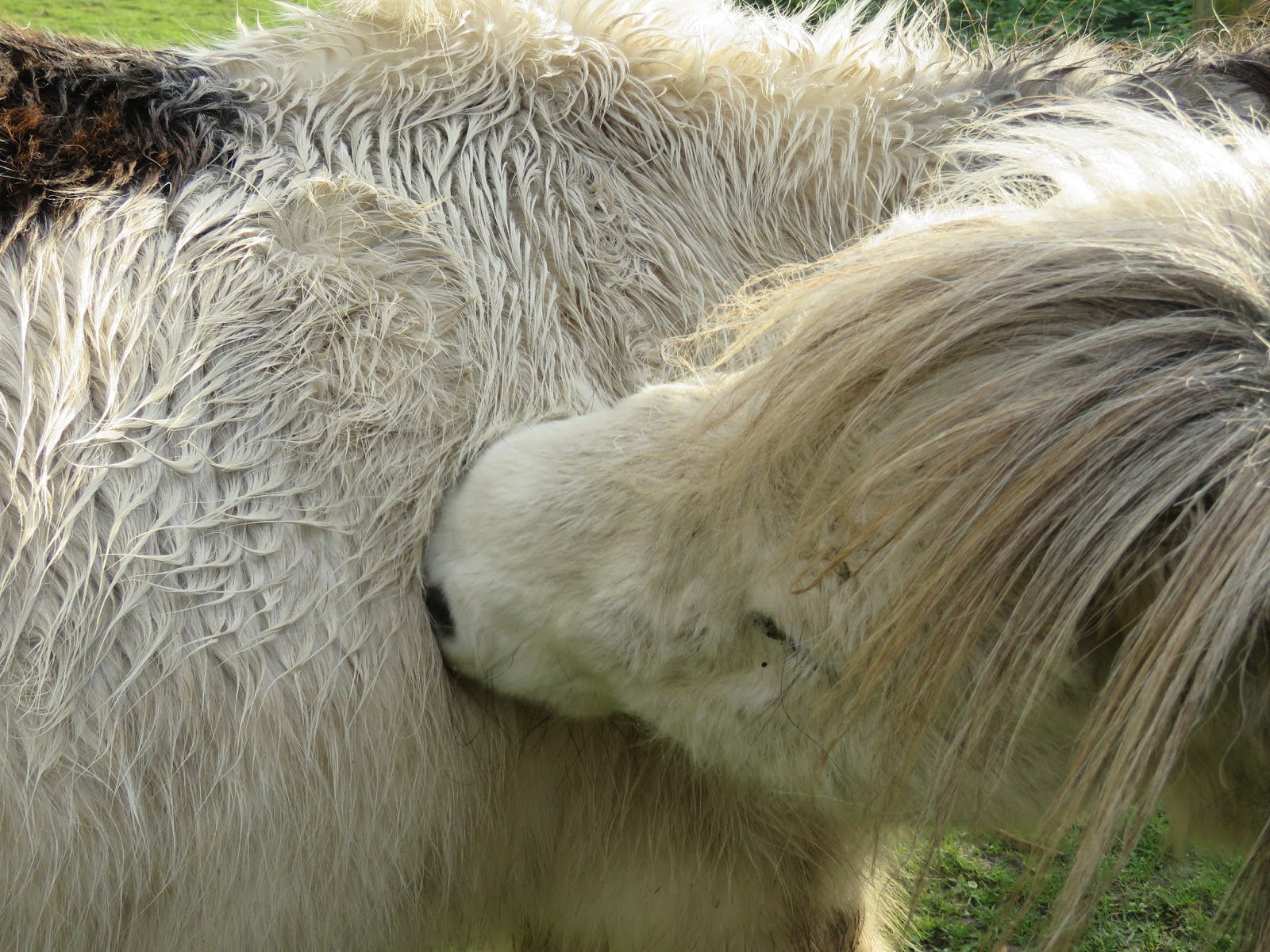
Itching on the fence


This particular pony in the image was itching itself extensively on the wire fence by rubbing its body and head up and down against the wire. This could be a sign of lice. In the summer this could also be suffering from sweet itch. This happens when a horse is bitten by a midge and the horse's immune system recognises foreign proteins and overreacts, similar to hayfever in humans. This leads to release of substances including histamine, which causes itching.


Feeding

Ponies are grazing animals, designed to eat little and often, and they have evolved to eat in 18 out of every 24 hours. They feed on grass in a natural environment, but when kept they are fed hay or hard feeds. They can also eat carrots, but due to having a relatively high sugar content, they should not be fed them too often. People feeding ponies carrots or human food can cause ponies to become addicted to eating human food, and can lead to them being aggressive in the wild with people who do not want to share their food. Human food also gives them bad stomach ache.


Lying down

Ponies lie down to get REM sleep - they can nap while standing but to deeply sleep they need to lie down. They sleep for about two and a half hours in a 24-hour period, in short periods of 15 to 30 minutes at a time. This is an adapted predator-prey response as in the wild it allows fast escape if they are already standing. Horses have a 'stay apparatus' in their legs which means they can relax their leg muscles and sleep without collapsing. They often do this when it is sunny as they find it relaxing. Ponies don't tend to lie down and sleep if they are on their own as there is no one to keep watch and their instincts tell them to watch out for danger. If horses don't lie down, they become sleep deprived after a few days.

Thursday, 10 November 2016

Myths of the magpies


Kingdom: Animalia
Family: Corvidae
Species: Pica pica
Magpies are common birds in the UK, and have quadrupled in numbers in the last 35 years. This increase is thought to be due to the amount of carrion from road kills available today, providing a year-round food source. They live in nests of sticks, mud, plant fibre and hair, which are usually situated in trees or bushes and love areas with scattered trees and shrub which include suburban areas. This makes the UEA campus a perfect environment, with plenty of trees and shrubs while still being a suburban area. The magpie builds its home "V" shapes in trees. Forks or V's in nature are symbolic of gateways or paths into the spirit realm and this is meant to ask us about our level of spiritual perception. They rarely travel more than 10 km from where they are born so most magpies born on the university grounds will stay here.


There are many myths and rumours about magpies and I thought I’d do them a favour and sort a few of them out:

1) They steal our jewellery!
Magpies are known for stealing sparkly and shiny objects such as jewellery, which is meant to be symbolic of our tendency to chase after false ideas or perceptions. However, recent research by the University of Exeter has shown that magpies don’t steal shiny objects, and are actually scared of them! This research may lead to a change in the definition of magpies in the Collins English Dictionary for a magpie as a ‘person who hoards small objects’. This may also have wider impacts, such as on the opera ‘La Gazza Ladra’ which is based on a servant girl being held responsible for a series of thefts which were actually committed by a magpie. This is now incorrect, and therefore makes little sense.

2) One for sorrow, two for joy…
Magpies are strongly associated with superstition, and has been since time as early as the sixteenth century, when the popular rhyme was first sung. The song has developed since these times with different numbers being given completely different meanings. There is clearly no truth in it, but it still remains a popular tradition in British culture today. There was once a tradition of raising your hat to a magpie, but as so few people wear hats these days, tradition has died out, although some people do still salute. They are associated with different superstitions in different areas of Britain – in Yorkshire they are associated with evil and you should make a sign of the cross to ward off evil, and in Scotland a single magpie is a sign of impending death!

3) They are responsible for songbird decline.
As we go into winter, the many magpies on the university grounds will be living off a primarily vegetarian diet, whereas in the summer it consists predominantly of ground invertebrates. In the spring, the magpie becomes a major predator as it has to provide for its young and it actually raids other songbirds’ nests and eats their eggs. It is often thought that this may be linked to decline in songbird numbers in the last 25 years, but research by the British Trust for Ornithology has found no evidence that increased numbers of magpies have caused declines in songbirds. It confirms that populations of prey species are not determined by the numbers of their predators, but instead by availability of food and suitable nesting sites are probably the main factors limiting songbird populations.

4) Magpies mate for life.
This is true, but is slightly more complicated than it seems. Magpies have a home territory of around five hectares, and between 25% and 60% of magpies in this area do not breed because nest sites are limited. They therefore form flocks with a home range of up to 20 hectares and then may pair up within the flock.

5) They have huge communal nests.
A typical magpie nest has a roof, and up to two entrances. Their nests are often adopted by long-eared owls. In the winter, these nests are shared by up to 200 magpies as they take part in communal roosting. This allows them to share body heat and decrease the thermoregulatory demands on the individuals within the roost. This is a behaviour also displayed in many other birds such as Jackdaws.


So some of the rumours are true, some of them not. Magpies do eat other birds’ eggs, but this is to feed their young and is not causing decline in songbird numbers. However, most impacts that magpies supposedly have on humans are not true – they don’t give us bad luck and they don’t steal our stuff. So maybe they’re not all that bad.